

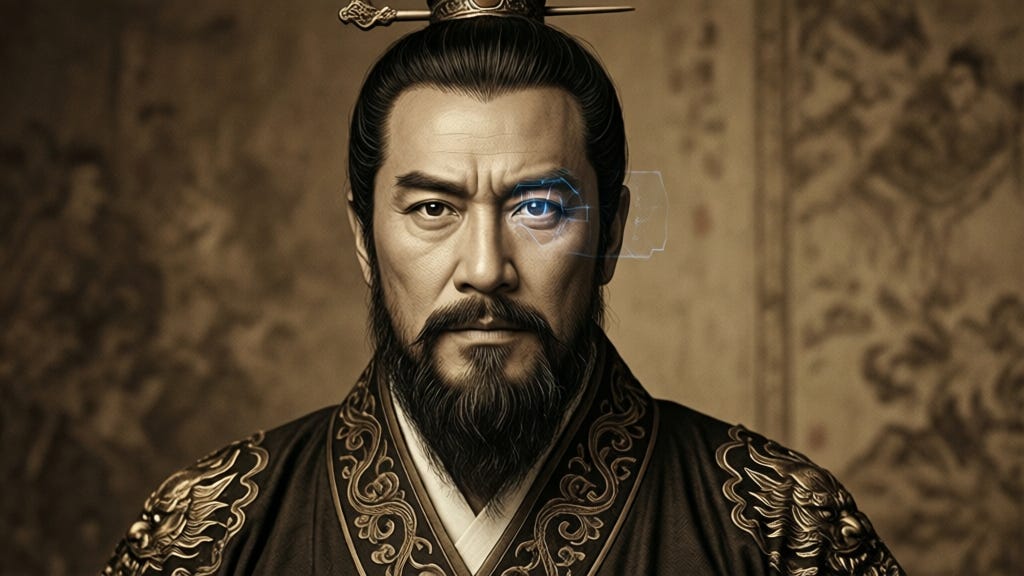
“All men can see the tactics by which I win, but none can see the strategy
from which victory is shaped” - Chapter 6. Sun Tzu, The Art of War.
I came across an Instagram post last week claiming you could unlock a hidden mode in Claude called “Sun Tzu Strategy Master.” The right phrase, it seems, would activate it. I can see that it received thousands of likes and shares. So I asked Claude if it has such a mode.
It doesn’t.
No secret mode. No hidden persona. No magic phrase that opens a back door to a smarter version of the AI.
But that post did get a lot of views. And it tells you something important about how most people still think about prompting in AI.
They think it is a key. They believe the right words will unlock a better version of the tool. Like levelling up in a computer game. They are searching for an incantation, a magical spell that no one else knows about, when what they actually need is something simpler. What really matters when using AI is providing clear context about your needs and goals, along with practical details that guide the AI to deliver the best possible output.
Of SWOTs and OKRs
Let’s take a moment to separate fact from fiction. We know that different prompts produce different results. Some shorthand actually does improve the output. Asking the model to run a SWOT analysis triggers patterns from decades of business strategy writing. “Setting up OKRs for your team” produces output that matches how OKRs are conventionally structured. Invoking Sun Tzu will bring up context from The Art of War.
Calling these “secret modes” overstates what is actually happening. They are compact ways of framing context that the model has already learned. Something called the “Context Compression” effect. Instead of writing a 500-word instruction on how to be a strategic genius, a user can use a “code” that acts as a compressed representation of those instructions.
This allows users to steer the model’s “vibe” or “persona” with minimal token usage. A short phrase can carry a lot of meaning, but only if the model has seen enough examples of it in its training. It only works when the shorthand maps onto something the model recognises deeply. Make up your own creative code, and the model fills the gap with assumptions, generic output, or confident-sounding nonsense.
The viral Instagram post misunderstood the mechanism. The real driver is context, and “secret code” is but one form of context.
When you type a prompt into Claude, ChatGPT, or Gemini, you are providing a brief. The model works with what it has. Give it clear specifics about who your audience is, what you need, and what good looks like, and AI will have something to work with.
The quality of AI output is almost never the “cleverness” of the prompt, but the context you provide.
There is no secret ingredient.
The idea of hidden modes works because they promise secret knowledge. Most people who use AI have felt the frustration of getting generic, hollow output and wondered what they were missing. A secret ingredient is a comforting explanation. It moves the problem outside of you and onto something you have not yet found.
There is no secret to unlocking better AI. The main takeaway is this: providing quality context with your prompts truly improves the output, not magic words.
Here is the gap I keep seeing. Some professionals use AI for quick answers and never go deeper. That is fine for a lookup, but it barely uses the tool’s capabilities. Others treat AI as a thinking partner. They give it context. They push back on the first draft. They iterate until the output is what they want. They produce work they could not have done alone.
The difference is rarely the tools. It is almost always how they communicate with the tool.
What this series is about
Over the next few articles, I am going to discuss what actually works and works better. It is the structural shifts that turn AI from an occasionally confused assistant into something genuinely useful. Like a true Sun Tzu.
You will learn why telling AI to “be Shakespeare-Warren Buffett” can make your prompts worse. The four elements every effective prompt needs. The information you are forgetting to give the model. Why your first prompt is almost never your best one. And the technique few people tried: getting AI to write your prompts for you.
Sun Tzu, for what it is worth, wrote about preparation and clarity. Apply that to how you communicate with AI, and you will not need a secret anything.
Coming next
PromptCraft v2 is in development right now. It pulls everything in this series and more into a working personal system you can use with any AI tool. If you want to be the first to know when it lands, subscribe to The Intelligent Playbook.